
Rep Sets: Variable Tempo Preparation
Situational micro-design

For the last several weeks, we’ve been reimagining music practice through the lens of design thinking. It’s amounting to a “starter kit” for music practice design:
Upgrading repetitions and gathering them into Repetition Sets1
Detailing the “core loop” of music practice and focusing on a single goal.
Keeping track of progress2
How to see and begin to feel the effectiveness of your practice.
Chunking and integration3
Using rep sets to take a whole piece apart and put it back together.
Nesting Rep Sets4
How to focus on small challenges then return to the bigger picture.
Using progressive tempo5
Designing your practice to develop speed, awareness, and tempo control.
Last time, we built competence at multiple steady tempos - an intentional way to develop both speed and control.
But tempo control means more than just playing steadily at different speeds. So this time, we’re expanding our idea of tempo: using tempo strategically and flexibly as a tool in practice design.
Why is this important? Because designing with strategic tempo flexibility strengthens our mental representations - our ability to imagine the music clearly, which is what allows us to play (and sing) the ways we’ve always dreamed.
One way we can do that is in the all-important preparation phase of a single repetition. In this phase, we will have just reflected on our latest attempt at playing. We should know what’s going well and what still needs attention. We may still want to remind ourselves of a small spot or two before we make another attempt. This is a crucial - and potentially difficult - moment in our practice. We can be uncertain, struggling with the possibility we won’t meet our goal. A “touch-point” at a tricky spot (or more) can boost our confidence as we gather our bravery for the next attempt.
Several years ago, I started doing what I now call “variable tempo preparation” for these moments of preparation, and I’ve used it ever since. The idea is to play through a passage without a steady tempo before the “scored attempt” repetition begins. It allows us to slow down as much as we feel we need to at trouble spots.
When you do it, it feels like playing with “hyper-romantic rubato”: slowing down and speeding up according to your feeling. You might play within the context of the whole passage, or you might spot-check (depending on the length of the passage you’re working on). But you slow down at the trouble spots. The whole point is to give yourself one last preparation run-through before the next scored rep.
Key principle to keep in mind: NO LOOPING! Stopping and going back to the same spot over and again defeats the purpose of this mindful preparation. Go as slow as you need to focus on each small action. (If your instrument requires breath (including the voice) - and you’re not focusing on elements other than breath - allow yourself to breathe when you need to slow down.) Try to maintain forward flow even at extremely slow tempos - but if you find yourself needing to stop repeatedly, pay attention to that information.
If you can’t get through even with maximum slowdown, you’ve discovered important information. Chances are you’ve got a bigger issue that you think. You may need to step out of your current rep set and do a quick redesign. You may need a different tool: a nested rep set; different chunking; or maybe realize you’re not ready with this spot right now and move on to something else. This is micro-level redesign happening in the moment. And this kind of flexibility is a feature of music practice design.
Last week, I was preparing to play for a Christmas gathering. In the song “The First Noel”, I had arranged a left hand accompaniment to go with the standard melody. I was happy with the arrangement, but there were some complicated chords toward the end of the second phrase. Here’s the score for first two phrases:
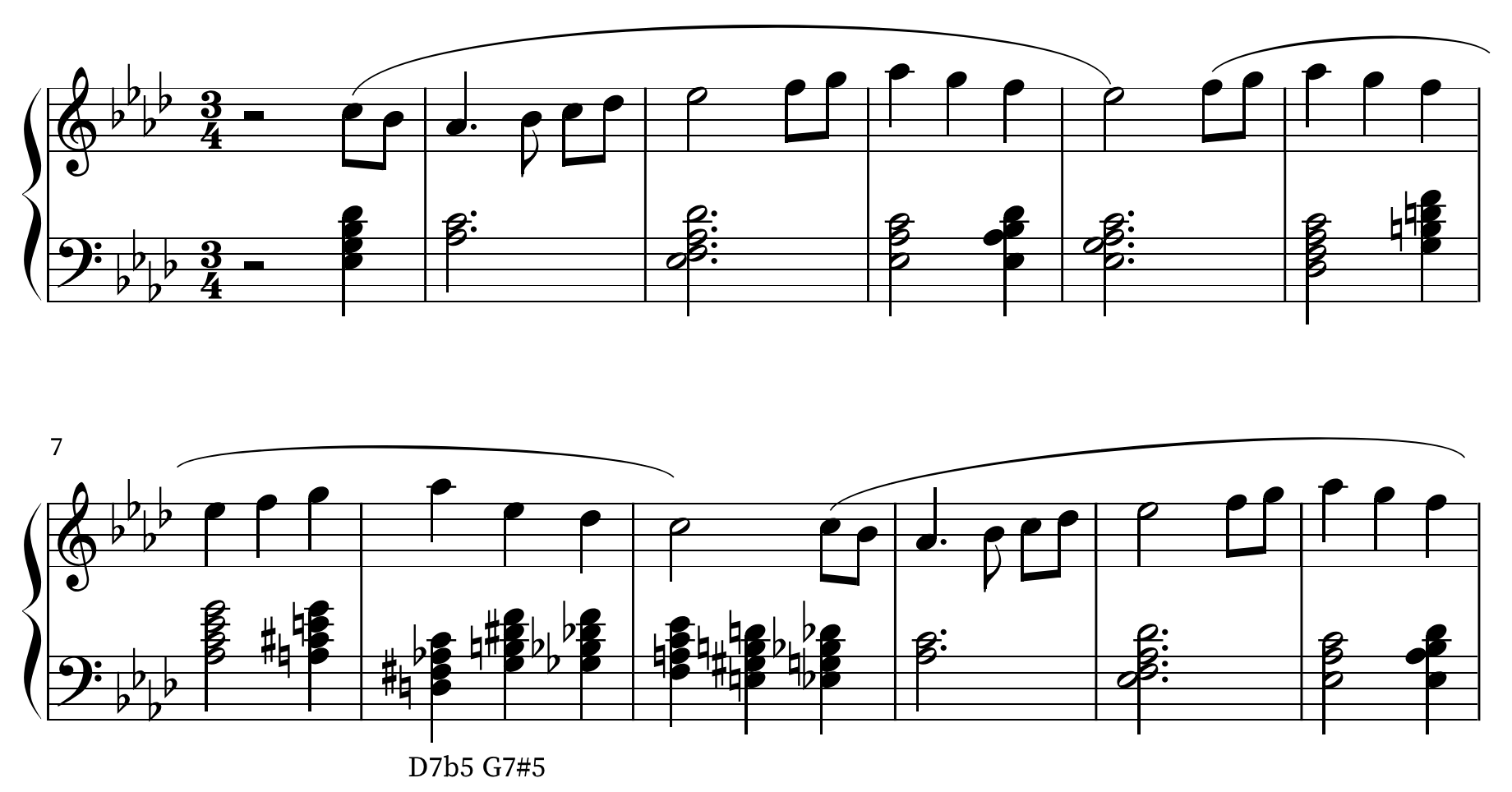
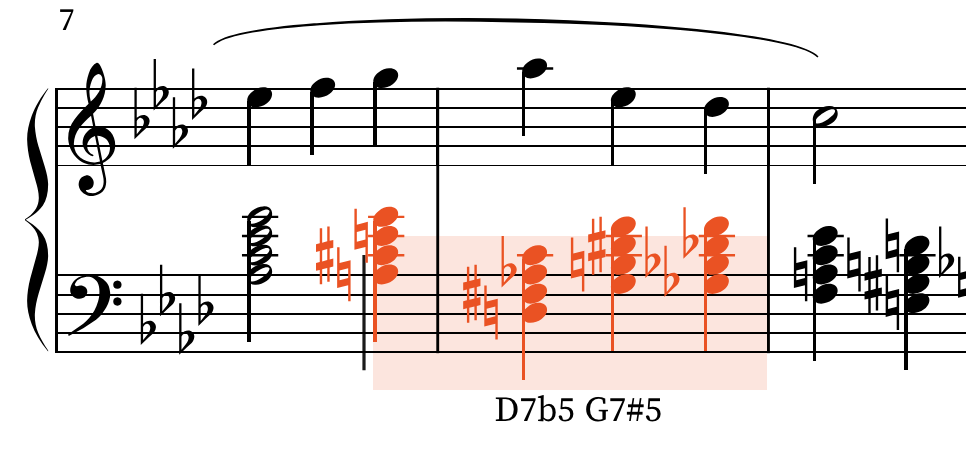
You can see that in the left hand of the second staff, there is a series of 4-part chords with a lot of extra accidentals. This created some confusion for me. 1) How the chords were going to feel in my hand (non-standard triads). 2) The leap down and back up in the second measure. 3) The enharmonic spellings of the Eb in the right hand and the D# in the left hand in the second beat of measure 8. 4) The unusual diminished-3rd intervals in beats 1 and 2 of the same measure (F#-Ab and D#-F natural). Here’s the highlighted area that I’m talking about:
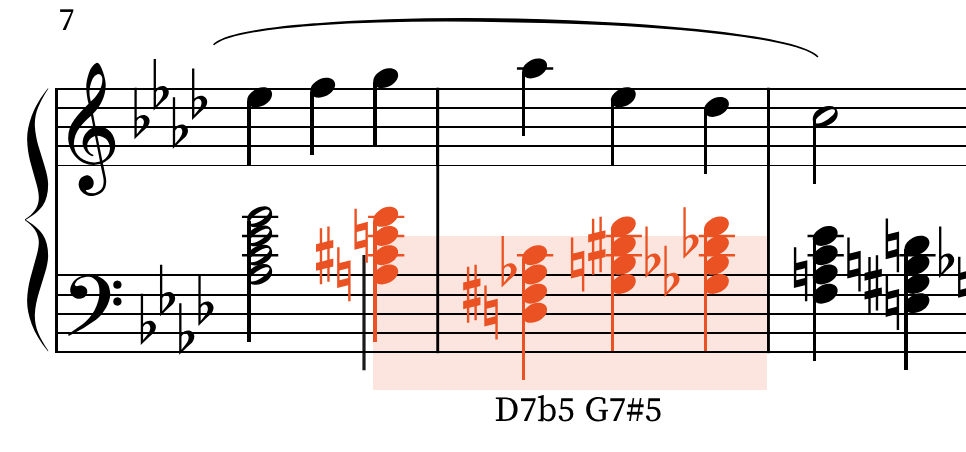
All of these unusual visual cues and sensory experiences required a lot of mental and tactile processing as I was learning these few measures.
So that day, the boundary for my rep set goal was those first two phrases. My musical goal was to play all the notes and rhythms correctly 2 times.
My first rep was going well until I came to that spot at the end of measure 7. I hadn’t prepared very well and neglected to remind myself of that tricky spot. I arrived there and panicked a bit, attempting to auto-correct and turning that lovely lullaby into a rude awakening.
During reflection, I remembered that all had gone well up to that spot and gave my arrangement a displeased look, trying to remember what those intimidating chords actually sounded like. Rather than playing the chords, I visually reminded myself what the chords were and imagined how they would feel in my hand to play them. Then I did the same again, this time including the right hand melody. I didn’t remember exactly how it was going to sound, but I was pretty sure I knew what it would all feel like.
However, I still wasn’t feeling very confident, given all that list of four challenges that I described above. I wanted to put the whole rep set in context, so I decided to do a variable tempo run-through as preparation, starting at the beginning.
I played the first phrase faster than performance tempo because it was relatively easy and I wanted to get to the trouble spot. Once I got there, I slowed WAY DOWN! I was very careful to make sure I was very clear about each chord in the left hand and each note in the right before I played them. With each beat, I was very conscious of what each hand felt like, willing myself to memorize the feeling. It went according to plan, and I felt better, but knew it was still going to be a spot to be very focused on during the next rep, so I completed my preparation with another reimagining of that spot without playing. After that, I took a deep breath to steady my nerves and focus my thought.
The next repetition started off well, as it had before. The first phrase went fine. And as I started the second phrase, I played with a much clearer image of what I wanted to play. It went very well. The only blip was that my thumb (playing the 7th of the G7#5) got pushed out of the way by my second finger on the D#. But, it felt like a victory. I played the whole thing through again two more times, both correctly, and called it good.
I was reminded again how effective this practice tool can be to clean-up or solidify a spot by giving more attention to the preparation.
Do you see why this tool was so effective?
Rather than diving into another repetition feeling uncertain or unprepared, we can slow down and give attention to the area(s) of concern.
Our mental representations are clearer about that concern before we start, and clearer when we get there.
The added clarity also gives more confidence to move forward.
We’re also reminded to make the most of the relationship between reflection and preparation.
Another insight this tool gives us is that tempo is not rigid or fixed. It is the beating heart of rhythm and the infinite variety of music. And as we saw here, in practice tempo can be used with flexibility as a micro-design strategy.
So for us, control is really about acting and responding with intention and wisdom. It comes from making the most of all our tools, experimenting with them, and getting good at using them. From the perspective of reimagining our practice to make it irresistible to us, control means freedom. Feel free to design practice that brings you joyful growth as both a musician and a human being.
We've covered a lot in the last few weeks. Keep us going!
Beautifully written