
Rep Sets: Progressive Tempo
Designing practice for speed and tempo control

Over the past few weeks, we’ve been building a toolkit for music practice design: repetitions and repetition sets1, keeping track of progress2, taking a piece of music apart and putting it back together3, and nested repetition sets4.
Today, we’re going to talk about something every musician deals with, but can be confusing or even intimidating in practice: tempo.
Tempo can be very precise. 71 beats per minute is a very specific speed, and with a metronome, you can know for sure whether or not you’re there. So, why the confusion?
Here are some ways it can show up in the practice room:
We don’t have a clear intention for our tempo - ‘whatever feels right’ or ‘however it comes out.’
We’re so used to hearing a piece at performance tempo that we feel we need to “be there” too soon and our playing remains sloppy.
We’re so tied to the mantra of “slow practice” that we never feel ready to speed up.
Using the metronome is difficult, so it ends up feeling like punishment or a chore.
It really all comes down to not understanding what it means to choose a tempo and why it matters.
Intentionally choosing a tempo isn’t just about “getting faster” or “using the metronome”. It’s about developing tempo awareness and control as a basic skill of musicianship.
The good news: you can use tempo variation strategically in your music practice design in ways that also build this fundamental skill.
There are multiple ways to use tempo strategically in your practice design. Today we’ll focus on the first: progressive tempo - systematically building speed across multiple rep sets. In future posts, we’ll explore other approaches like variable tempo and playing out of tempo, which serve different purposes.
The first way to use tempo strategically is called progressive tempo. Here’s how it works: you start at a tempo where you can play accurately, then systematically increase speed across multiple rep sets.
Here’s what a simple progression might look like:
Play measures 1-4 at 60bpm, 3 times correctly.
Play measures 1-4 at 80bpm, 3 times correctly.
Play measures 1-4 at 100bpm, 3 times correctly.
Remember: it isn’t random increase of speed - it’s an intentionally designed progression. What tends to work best (and is more fun!) is to make each tempo setting (or “level”) its own rep set. You only move to the next tempo when you’ve succeeded at the current one. In this way, each tempo tests (and builds) your control at that specific speed.
Because you’re performing multiple repetitions at each level of speed, you’re reinforcing your ability to play that section of music AND developing the skill of tempo control at the same time. Instead of “pushing to get faster”, you’re progressively developing your mental representations of the same musical material.
One of the biggest benefits to using progressive tempo is how it helps you “design for flow”5. You intentionally calibrate each increase in tempo so that it’s challenging but attainable.
If you use a metronome, you can develop your awareness of it, as if you had a conductor to lead you. Then, the metronome becomes a training tool, not a burden.
Now, let’s take a look at a more detailed example of how progressive tempo works “in the wild”.
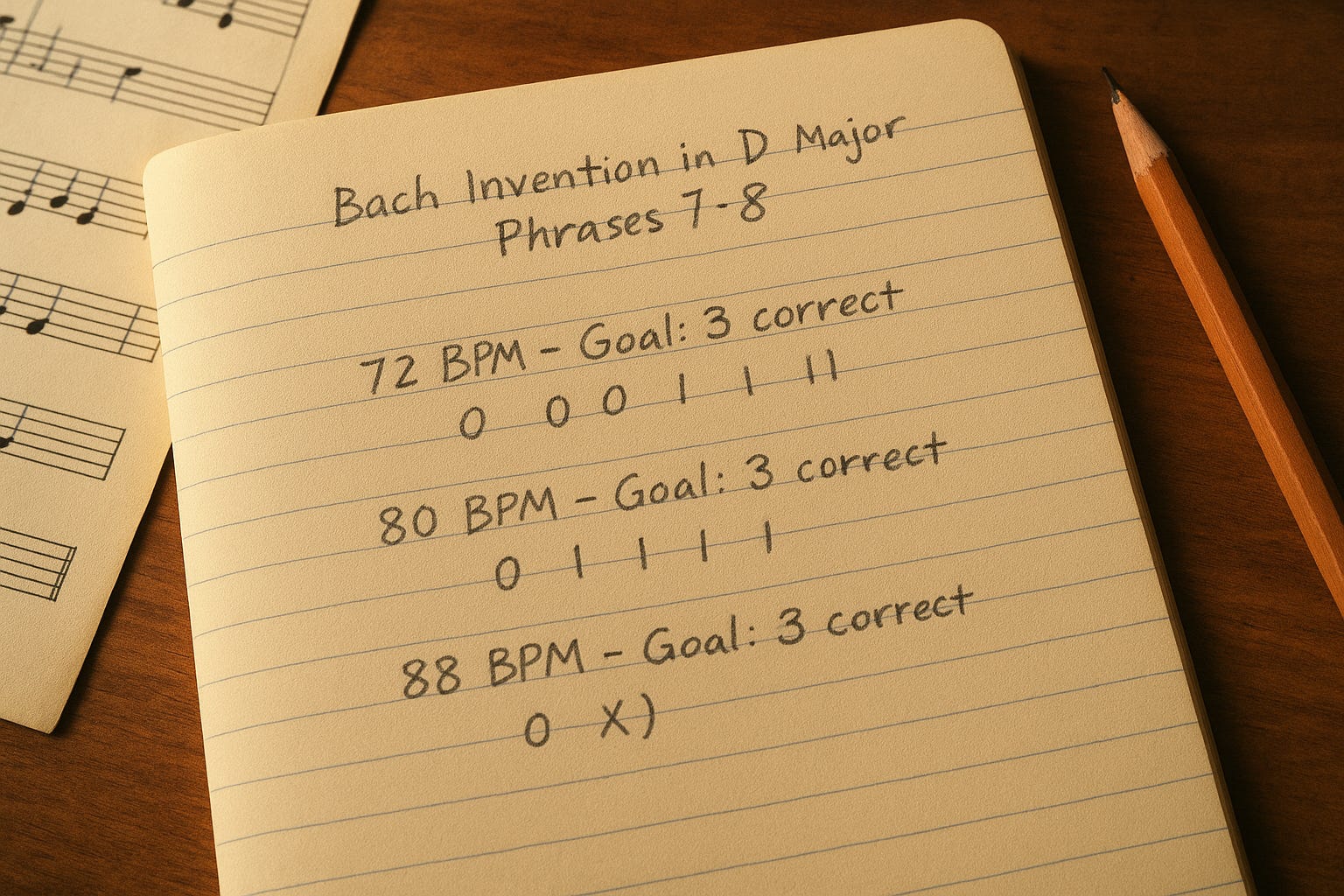
This is from a practice session of mine working on the Invention in D Major by J.S. Bach. Specifically I was working on phrases 7 and 8 (about 16 measures total). I had all the notes and rhythms and fingerings down, so I was just working building tempo. The basic goal here was to get each rep set correct 3 times.
The first rep set was designed to start at a tempo slightly slower than the previous session on these phrases: 72 beats per minute (BPM). The hope was that this tempo would allow me the probability of playing accurately, but not be so fast that it would challenge me too much. I began the set feeling confident that it would be a simple review.
Here’s my progress tracking from that first rep set: 0 0 0 1 1 1. As you can see: the first 3 were misses and last 3 correct. Apparently I needed more review at that tempo than I anticipated. It was one of the more challenging sections of the piece. I was a bit disheartened that it took me so long to get back to where I had been. But it turned out okay, I eventually got 3 reps correct in a row! The turnaround was unexpected, and a big relief.
(Quick note: if you’re interested in learning about progress tracking (or “keeping score”), this previous post6 has the details.)
The second rep set was designed to build on the success of the previous set. This time the tempo was 80 BPM (8 faster than the previous set). Fast enough to be challenging, but also not too much. Here’s the tracking: 0 1 1 1. The first rep still had a couple misses; and again, I finished with 3 correct in a row. That felt like a BIG win!
The final rep set was designed to push me beyond what I had done up to that point with that piece: 88 BPM. Here were the results: 0 (X). I stopped in the middle of the 2nd attempt; it was a train wreck. I thought it could be doable; and I quickly discovered that tempo was still beyond what I was capable of for that section. I missed the first attempt, and then struggled so much in the second attempt that I decided to come back to it another day.
During my reflection for that session, I felt good about the overall challenge I’d designed: a review that wasn’t easy but was doable, a middle level that solidified my progress, and a final push that showed me my current limits. Excellent reinforcement - and a clear challenge for next time.
I hope you can see now that the idea of progressive tempo isn’t about “getting faster” until we “attain” performance tempo. What we’re really aiming for is developing the core musical skill tempo control. And we do this while we build technical fluency with the music we’re learning to play.
Along the way, we also leave behind our previous habits of vague tempo, random attempts at building speed, and experiencing the metronome as a straitjacket.
Once again, design thinking comes to the rescue! We use intentional and gradual change to maximize our learning. We’re not hoping to get faster, we create an approach that makes progress achievable. And, as we saw in the example, we discover where we are and what we’re ready for next.
What piece are you working on right now that could use some progressive tempo practice? Try three rep sets with the same music: review, likely success, challenging limits. Did you make it too easy, too difficult, or just right? What did you learn about the music, your current ability, and how to design your next progression?
As promised, there’s more to explore. Soon we’ll consider other approaches to tempo that give us more options, more tools, more possibilities.
In the meantime, remember: you can design practice that you never want to stop doing. That’s the opportunity. Turn it into a commitment, and come back here for more tools to help you do it.
What a cliffhanger! I hope you conquered that last section! Really—good explanation of how repetition is more of a tool than a habit.