
Music Practice Design: Two First Steps
The Basic Rep and the Rep Set

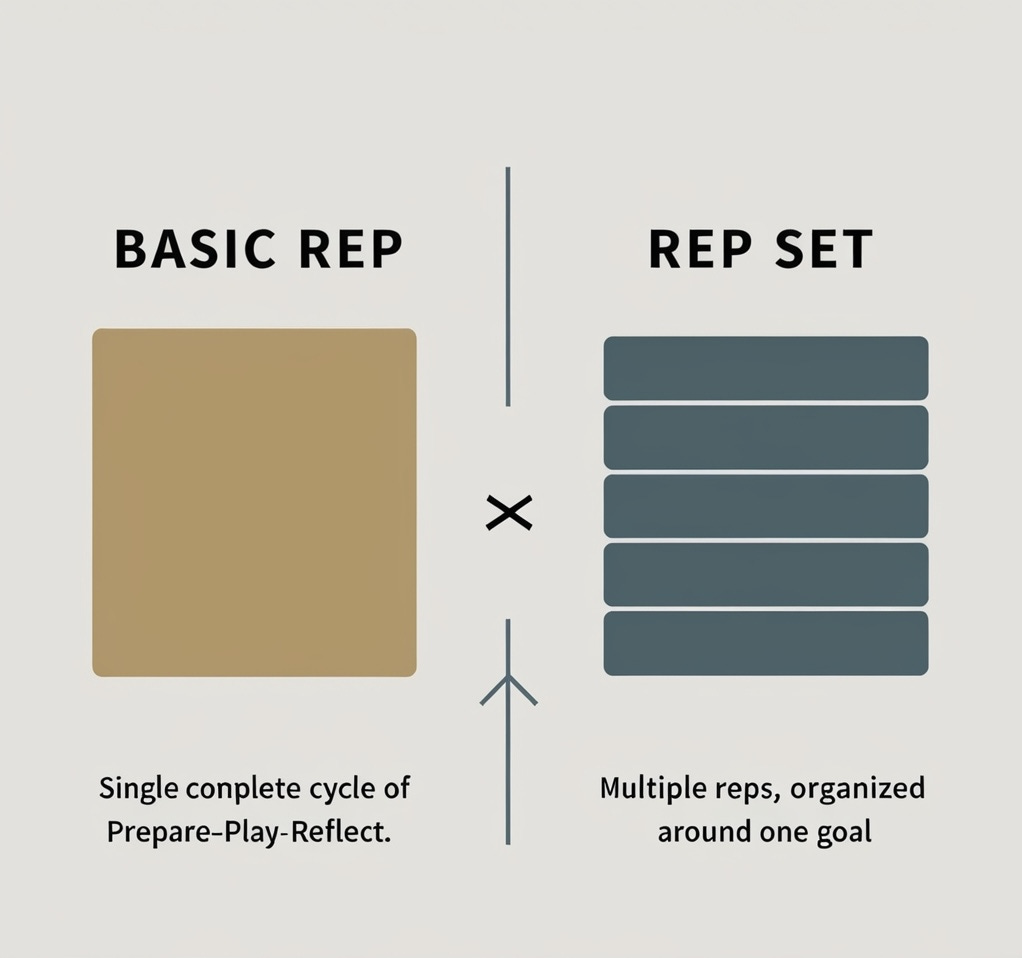
If you’ve struggled with music practice; if you find that traditional practice isn’t working for you; and if you agree that purposeful practice is the likely solution to the problems of traditional practice, I have 2 initial steps for you.
Upgrade the way you do repetitions
Begin to group those repetitions to focus on specific goals
You can find out how to do Step 1 here1. But the basic idea is to:
Prepare before you play so you have a clear idea of what you want to do
Play with intention, according to the way you imagined during preparation
Stop and reflect on whether you played the way you intended and imagined
Step 2 makes the basic rep exponentially more effective and potentially enjoyable. This is where you begin to design music practice and where it begins to feel like playing a game.
This post will describe step 2 in its most basic form. In later posts, we’ll discover some of the many ways to design a set of iterations pointed to developing a single musical goal or skill.
The main idea behind a set of repetitions (or “rep set”) is very straightforward. Here is a clear example:
Play measures 1-4 correctly 3 times
It’s really that simple. To start. As I said, I’ll be sharing more about how to make it flexible and versatile in later posts (all focused on the same goal of teaching the rep set!).
For now, it’s helpful to know that the move from single to multiple repetitions is completely natural, definitive, and therefore obvious, even from the perspective of traditional music practice.
What makes it potentially exponential in its effect is the compounding of the cognitive benefit that I described in “The Virtuous Cycle”.2 The cognitive benefit here is the increasingly powerful development of the mental representations you have of the music and how to play it.
The example of the main concept is just the most basic. The idea is that anything that you need to practice can be designed as a set of repetitions. Here are a number of other possibilities:
Play measures 1-4, the left hand part only, 5 times
Play measures 5-8, focusing on the bowing, 3 times correctly in a row
Play the motive in measures 125-126 out of rhythm, focusing only on the embouchure, 6 times
Play the verse of the song to explore phrasing until it feels tedious
Play measures 8-10, focusing only on rhythm, until I feel comfortable with it
Play measures 9-12 5 times starting at 40 beats per minute and gradually increasing to 80 beats per minute
This list is still only a basic sample. There are many variations—tracking results, adjusting parameters, exploring different focuses—all of which we’ll explore in future posts.
By the way, I also discovered that “tracking results” is another term for “keeping score”; and this is a hint at one of the ways we can begin to experience music practice as a game!
There they are: the first two steps into purposeful practice design. The (upgraded) Basic Rep and an introduction to the Basic Rep Set. My intention is to give you enough information to get started making and using them yourself without so much detail that it gets confusing or overwhelming.
If you start with a clear and straightforward musical challenge, and apply the basic rep (prepare, play, reflect) to each time you play, how do you imagine your practice will be different? From my experience, it can make learning music more creative, fun, and even exciting because during each repetition I know what I’m trying to do and I’ll know when I achieve my goal.
I invite you to make a first attempt (a “prototype” design) and reflect on what works and what doesn’t. Then imagine on how you can make it better next time.
Let me know how it goes. I look forward to hearing from you!
My earlier post, “The Virtuous Cycle”
Got it! Repetition.I'll try it.