
Rep Sets: Chunking and Integration
Building the whole from the parts

In previous posts, we’ve uncovered two steps you can take to significantly redesign your music practice: upgrade your repetition and begin to use repetition sets (aka, “rep sets”) 1. Then, we began to see the rich game-like possibilities of rep sets by keeping track of our progress.2
Rep sets help us to design practice that focuses on specific goals.
So, how can we use this design tool to learn a whole piece of music?
The answer comes from learning science.
Break the piece into chunks
Practice each chunk as a rep set
Then gradually recombine them until you’re playing the whole piece
In this way, we’re taking the basic ideas of repetition and repetition sets to their next level of practical application.
I’ll show you how this works with a simple example.
Designing Chunks
First, we’ll talk about chunking. This is where we break the piece into manageable sections.
So, how do we decide what’s “manageable”?
Applied to music practice, this is generally based on:
the musical form
areas that need more focused effort (discovered through reflection during repetitions)
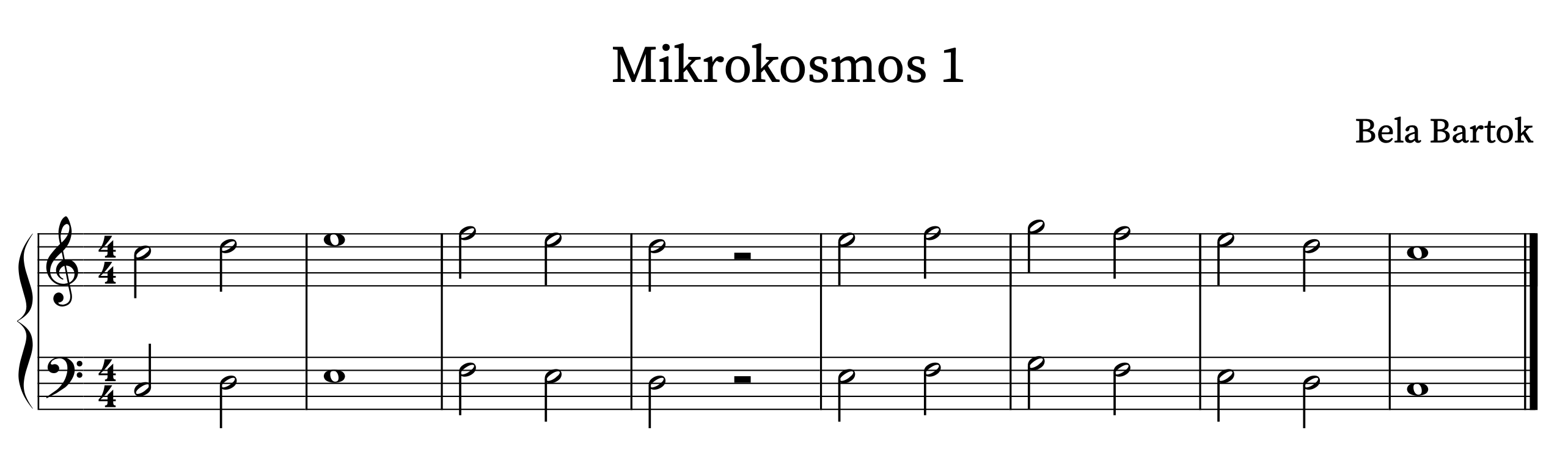
Our example is an entire piece that’s 8 measures long. It’s titled “Mikrokosmos #1” by Bela Bartok. Here’s the whole piece:
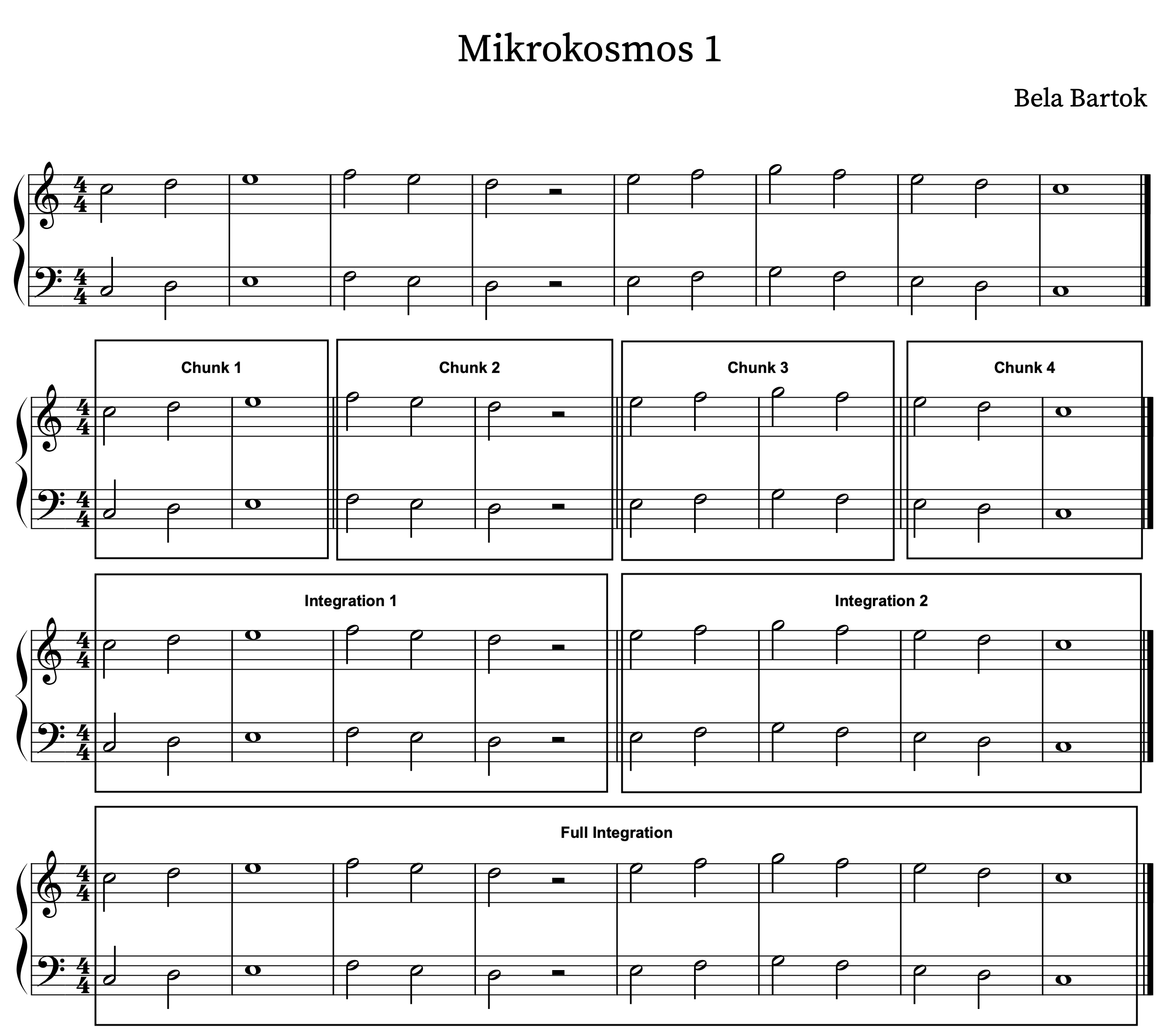
For the purpose of this demonstration, I’m going to divide it into four 2-measure chunks. I’ve based the decision on the form (2 phrases of 4 measures each; each phrase further divided into two sub-phrases of 2 measure each). A hypothetical beginning piano student with sufficient preparatory instruction would probably find these chunks manageable. Here’s how the chunking looks:

Now we’re ready to design our practice. Each chunk becomes an individual rep set.
For Chunk 1, we set the goal:
“Play measures 1-2 with the correct notes, fingers, rhythms, and rests 3 times.”
Once we’ve reached that goal, we set the goal for Chunk 2:
“Play measures 3-4 with the correct notes, fingers, rhythms, and rests 3 times.”
We continue in the same way with Chunk 3 (measures 5-6) and Chunk 4 (measures 7-8).
Now we’re ready to practice.
Let’s assume we reach all our initial goals.
Designing for Integration
Our next series of steps is to put those chunks back together in a systematic way.
First, we recombine adjacent pairs, two at a time. Again, we’re following the form of the piece. This makes the process feel “musically natural”. Here’s the first level of integration:

Now, we’re ready to design the next group of rep sets. We’ll use the same design template we used for each chunk. So, our “next level” goals are:
“Play measures 1-4 with the correct notes, fingers, rhythms, and rests 3 times.”
“Play measures 5-8 with the correct notes, fingers, rhythms, and rests 3 times.”
We’ve designed our new goals, we’re ready to practice.
Let’s assume we reach those two goals.
Our final step is to recombine the 2 sections into the whole piece. The last level of integration looks like this:

This approach turns practice into play because our new goals are challenging yet reachable - “reachable” because we’ve been learning what we need to know during our previous goals.
Looked at another way: with each level of integration, we’re reinforcing skills (creating stronger mental representations) we worked on at each previous level
This approach to learning a whole piece of music is flexible yet robust. As you use these tools over time, you come to understand how you can apply them to your individual needs at each turn of your practice journey. You get better at learning how to learn as you get better at using these practice tools. You’re beginning to feel - through experience - the multiplicative power of repetitions and repetition sets.
Designing for Flow & Designing for Artistry
Can you see the progression?
Repetition, focused on a single goal, becomes repetition sets.
Repetition sets, thoughtfully and creatively designed through chunking and integration, become a whole piece.
This progression lights the stage for creating states of flow3. Your goals are consistently challenging and yet attainable. If you’re keeping score4, you’re giving yourself visible progress tracking. Early wins lead to earned confidence.
Stronger mental representations of technical skills mean that you will be ready to work on interpretation and artistry sooner rather than later.
All of this comes from using tools to intentionally design your practice rather than relying on traditional methods of intuitive learning.
While these tools are sufficient for you to get started and begin to experience the difference, there’s still more possible with rep sets.
The best way to develop the skills of music practice is to intentionally plan (aka, design) to use the tools to solve problems (aka, learn to play a piece of music artfully).
So, I invite you to make a “beginner’s attempt” (aka, prototype) to design your practice. Use the tools of repetition, repetition sets, keeping score, chunking, and integration.
As you do, ask yourself, “In what ways can I naturally break this piece into sections?”
As you practice, notice:
what happens when you practice using chunks?
how does it feel when you start to integrate?
are you able to focus on each of the repetition stages (prepare, play, reflect)?
As you reflect on the overall process after each practice session, do you sense other possible uses for rep sets? What would those possibilities look like in practice?
The most important reflection is that your music practice is for you. As you practice designing goals (rep sets) and daily sessions, make sure they are things you want to do and have fun doing! Otherwise, practice becomes a chore. That means that you won’t want to do it and you probably won’t reach your goals - short term or long term.
If making music is a lifetime goal of yours, use these tools to reimagine what is possible for you!
Glanced at this earlier. Just took the time to read it in full and with the images downloaded. I'll try to apply chunking to art and writing disciplines. I just play music by ear.