
Rep Sets: Keeping Score
How tracking transforms practice

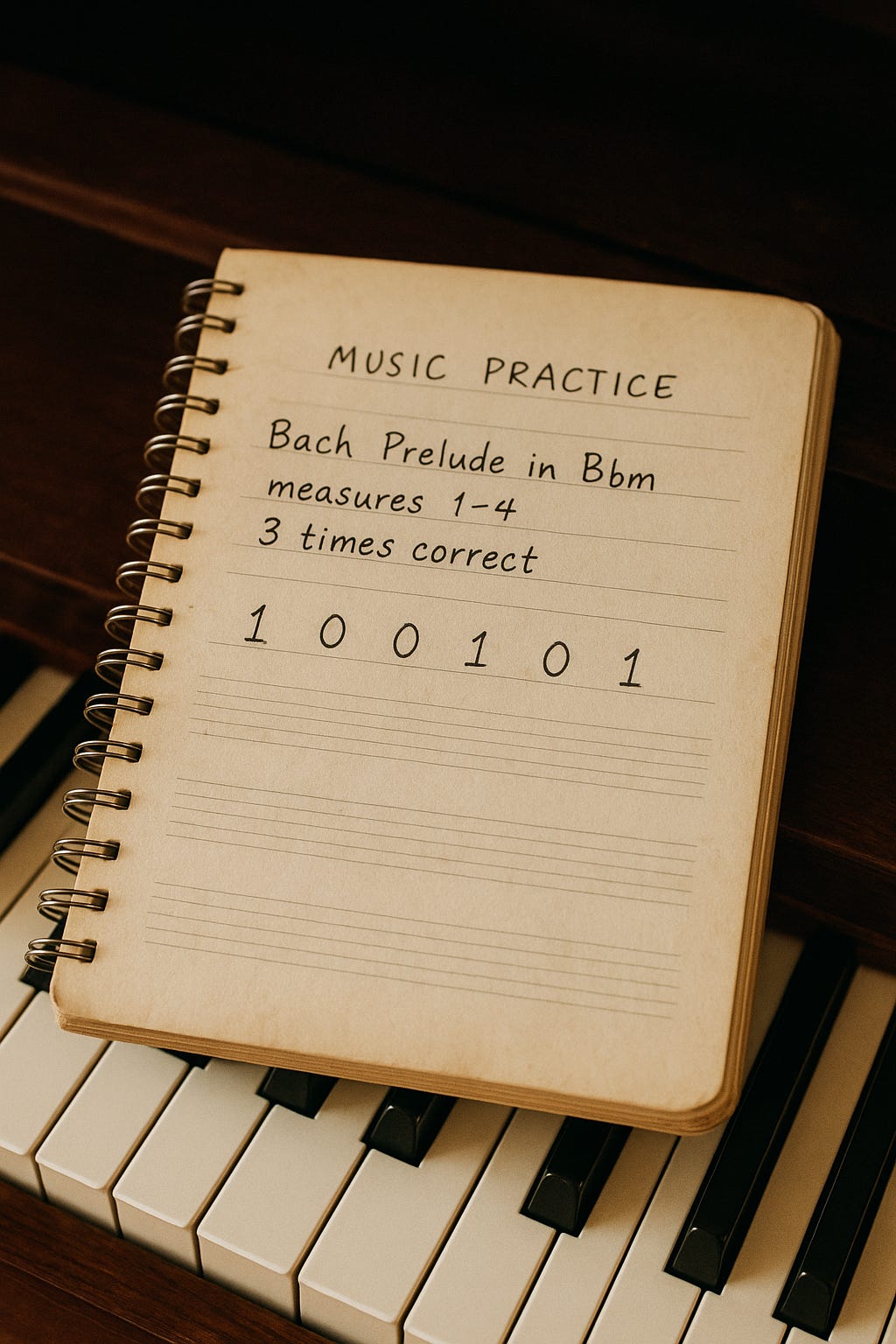
In a previous post1, we began to uncover the music practice design concept of repetition sets. A primary question of goal setting is: how do you know when you’ve reached your goal? The solution requires two interrelated elements: a clear definition of what “reaching the goal” looks like, and a mechanism for tracking that progress.
This is one of the things I discovered I needed when I first began to upgrade my music practice. What I didn’t discover until later is that this fundamental decision turned out to be a powerful internal motivator and a key element for creating flow states.
Before you can keep score, you need to define your goal clearly.
One of the features of music practice design is that repetition allows us to build the end state of the goal right into the goal description. I learned three effective ways to do this:
Play X repetitions
Play X repetitions correctly
Play X repetitions correctly in a row
The most common is probably #2. You might create a goal like: “Play measures 1-4 correctly 3 times.” The word “correctly” carries a lot of weight here. We’ll explore ways to clarify what “correctly” means as we continue. For now, let’s focus on the tracking mechanism that makes this goal achievable.
Keeping score is simple: you track whether each attempt succeeded or didn’t.
During the Reflect stage of each repetition, you evaluate whether your playing matched your goal. If it did, you give yourself a point. I keep score with “1” for a point and “0” for no point. Here’s what it looks like:
1 0 0 1 0 1
Six repetitions total: three played correctly, three were not. In my notebook on top of my piano, it looks like this:
Bach Prelude in Bbm, measures 1-4, 3 times correct: 1 0 0 1 0 1
You have a written record of your session—proof that you met your goal. I’ve discovered it often triggers memories of how that practice felt. How did it feel when I got the first one right but missed the next two? Did I lose hope? Then I got the next two of three correct and won the game (reached my goal)!
This is where the game-like feeling comes up.
You may have noticed I’ve been referring to a rep set as a “game,” and “reaching your goal” as “winning.” This is intentional. Designing and enacting a rep set shares key elements with playing a game: clear objectives, rules and constraints that create structure, and immediate feedback systems.
My early experiences became game-like before I even realized it. Each goal became a mini-drama with clear stakes, emotional ups and downs, genuine feelings of achievement. This led to growing internal motivation as days turned to weeks.
These are lived experiences, not research. But there’s substantial research supporting how game thinking enhances skill building and motivation. The combination of design-based learning and game thinking creates what I call an alchemical psychological catalyst: autonomy (you control your practice), mastery (you journey toward skill development), and purpose (you’re becoming the musician you want to be).
Ready to try it out?
If this sounds worth exploring, start with these three steps: upgrade your repetitions using prepare-play-reflect, gather them into goal-focused sets, and include score keeping. As you design, notice: Is my focus improving? Am I enjoying practice more?
Remember: your music practice is yours. You own it. Make it into something you’ll want to use. Be intentional, and enjoy the process!
What’s a piece of music you’re working on now that you can try this three-step process?
I've been doing this for about a month now, and I can attest to its effectiveness. My practice finally has structure (as opposed to playing bits and pieces of whatever I felt like playing).
The one thing I'm finding frustrating though is when I have a little "winning streak" (several days in a row where the 1's outnumber the 0's) and then suddenly have a crap day where my fingers just don't seem to work at all (6 zeros in one day is very demotivating!). How do you overcome these bumps in the road Paul? - Katherine
Your post makes me realized that the action of practice drives transformation.