
Rep Sets: a Nested Approach
What to do when you get stuck mid-practice

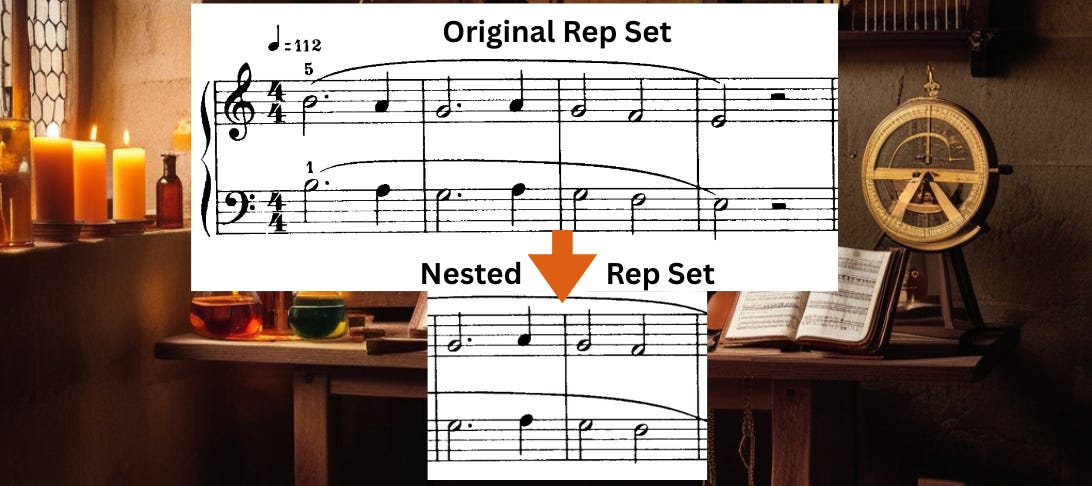
If you’re looking to improve your music practice, you’re in the right place.
Over the past few weeks, we’ve been building a toolkit: basic reps and rep sets1, keeping score2, chunking and integration3. Today, we’re adding another essential tool: what to do when you hit a wall mid-practice.
Imagine this.
You’re in the middle of a set of repetitions, working toward a goal. For the most part, things are going well. But something’s not working. Maybe it’s a technical issue - awkward fingering, rhythm tripping you up, coordination between hands, breath, bow, etc. Here’s how it usually unfolds:
Your first attempt isn’t completely correct.
Next rep, you try again - still not getting it.
A third time - nope.
The self-talk starts: “I’m doing something wrong.”
Now you’re grinding! You’re convinced that if you just try harder, you’ll start to get it.
Fourth rep attempt, from the beginning. You get to that same spot. Same problem.
Frustration begins to fill your mind: “Why isn’t this working?”
You keep trying to power through - more failed attempts.
If you’re keeping score, you see a line of nothing but zeros.
Now you’re into overwhelm: “I can’t do this. It’s pointless.”
Does this sound familiar?
We’ve all been there - and it sucks.
Fortunately, there’s a way out. Here’s what you can do next time you find yourself in this trap:
Step out of your current rep set.
Clearly define the specific problem you’ve identified.
Design a new rep set to address that problem - and nothing else.
When you’ve reached your new goal, go back to the original rep set where you left off.
I call it a “nested rep set”. It’s a variation on chunking and integration - classic learning science. In this case, you come out from a “work in progress” to focus on a small chunk - whatever that isolated problem is. Then, you focus on that until you’re ready to integrate it back into its original musical context.
This is what music practice design can feel like. Instead of grinding effort, you have a tool. Instead of overwhelm, you get relief. You don’t hope it gets better - you pause, design a solution, and move forward.
Let’s see how this tool works in detail.
Sandy is a beginning piano student who is learning to read and play rhythms. She is developing a new skill: understanding the difference between a dotted-half note and a half note without a dot. She is working on one of the Mikrokosmos of Bela Bartok. Here’s the rep set she’s working on:
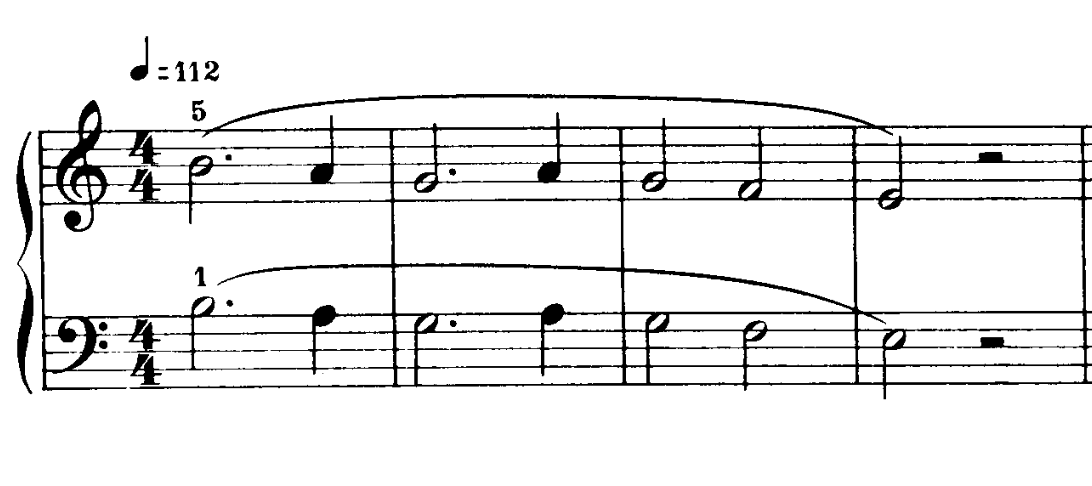
The first four repetitions all proceed the same way: she can play the first two measures with the dotted-half note and quarter note, but when she gets to the 3rd measure, she has trouble playing the rhythm of two half notes correctly. The mental image she has of the difference is still under construction (so to speak).
(Don’t judge. Some people may find this example overly simplistic. Challenges come in all forms. If it helps, recall or find a challenge for you as you imagine how this tool works.)
During her reflections, Sandy begins to get frustrated at her mistakes but is able to stay focused enough to isolate the problem she is having. So, she stops work on the rep set with the four measures and designs a new rep set focusing only on the rhythmic change. Here’s what the score for her new rep set looks like:
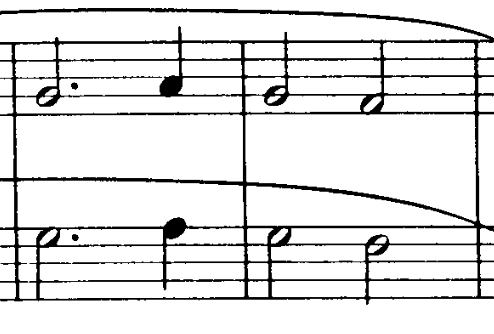
Here’s the text of the goal she designed to go with it:
“Play these two measures correctly 3 times in a row, counting out loud, at a slower but steady tempo”
As she prepares for her first repetition, she’s not as frustrated as she had been - she has literally cut in half the amount she has to play - so she can focus all of her mental and emotional energy on the single intention of moving from one rhythmic pattern to another. She’s still a bit nervous - because it’s still a challenge - but feeling much more confident that she can do it.
She begins her first repetition by closing her eyes and imagining herself playing the rhythm correctly and counting the beats slowly out loud. Then she opens her eyes, concerned but brave, and begins counting the beat. She plays on the first beat, counting patiently, and plays the two measures exactly as written. She finishes playing and is relieved. She takes a deep breath and begins to prepare to play again. She plays the second time, exactly as she prepared and exactly as written. During her reflection, she notices her nervousness has moved to relief and now confidence. She is ready to make this the last repetition of this nested rep set. And she does. Now, she feels invigorated at having reached her new goal.
She then returns to her original rep set. This time, when she reaches measure 3, although she is nervous, the rhythm is correct, but does not yet flow naturally - and, she completes all four measures correctly. Next time, when she reaches measure 3, she is less nervous, and the rhythm feels more natural; again she completes all four measures correctly. Last time, she is full of confidence. She plays all four measures as a unified phrase; the rhythm and the notes all falling into place. Success - she’s now reached her original goal!
As you can see, Sandy’s breakthrough was both practical and psychological, and it came from using a nested rep set.
We can use it instead of grinding our way out of being stuck. This “set within a set” gives us a way to step out, focus on the problem, then step back in when we’re ready.
Instead of overwhelm, we get a clear next move. Instead of hoping it gets better, we empower ourselves to design a solution and see it through!
Don’t let practice become a chore. Next time you feel frustration creeping in, stop. Remember: you can pause, focus on exactly what’s not working, fix it, and return to finish what you started. That’s the purpose of having a tool and using it to design music practice that is effective and fun!
Excellent analysis! I realy resonate with 'design a new rep set to address that.' It’s such a smart, structured approach to problem-solving, not just in music. Reminds me of debugging code – isolate the issue, then build a targeted solution. Very insightful.
Your opening description is me to a tea Paul! Thinking that if I just power through it will all come together (spoiler: it doesn't). I tried the "isolating one part and getting it right" strategy yesterday and it helped me get through a particularly vexing part.
Your tips are simple, but powerful tools in helping me work through my perfectionism. Thank you. - Katherine