
Playing Honestly
How do we practice when no one is watching?

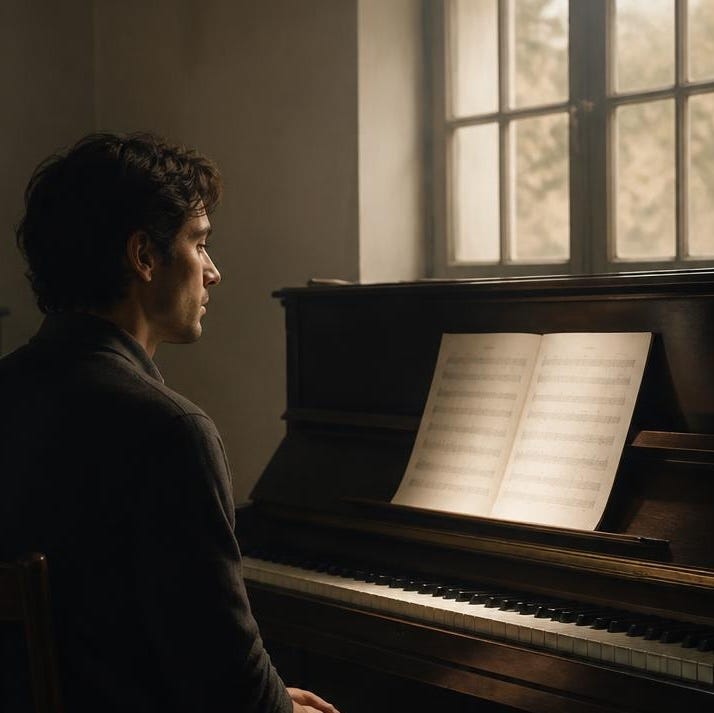
I’m alone in my practice room. There is no audience, no teacher. Whatever happens in this practice session, no one except me will ever know.
I’m working on a piece that’s a big challenge. I’ve set a goal: for each repetition, play measures 1 through 4 at 70 beats per minute, getting all the notes and the rhythms correct – no errors. And I’m going to play this way 3 times. This is my design for this set of repetitions.1
The first two repetitions go according to plan, and I have one more to be played correctly to reach the goal for this rep set.
My 3rd rep has a couple of problems with the rhythm. So, I need a 4th rep to attempt to reach my goal.
In the 4th rep, I miss a couple notes, but the rhythm is correct. So I need yet another rep.
This time, I miss a single note at the very end, but the rhythm is correct.
I pause. I admit that I’ve made a mistake. But, I ask myself: do I really need another repetition? I think, “It was only the last note. I got everything right the first two times; and mostly got things right the next two times; and I got everything right except the last note that last time. I know it well enough. Should I just move on?”
This moment is what I want to talk about. It is a moment of decision that we arrive at fairly frequently.
And it comes with a very pointed question: when no one is watching, what keeps practice honest?
Johan Huzinga2 has a name for this moment: the ethical tension of play.
The tension looks like this: the player wants to win, “to achieve something difficult, to succeed”. The ethics of play test the player’s courage, tenacity, and honesty. Do we stick to the rules of the game? If so, the play of the game continues. If not, “the whole play world collapses”, and “the game is over.”
For musicians, we are simultaneously the player and the referee. If we do not follow the rules, the game ends, and our practice devolves into an exercise that is both mechanical and hollow. We suffer the consequences of our choices, and we have no one to point to but ourselves.
For much of my musical life, this is what practice felt like to me: largely bewildering and frustrating.
Practice was an open-ended requirement with few clear guidelines, and no way to know when I’d done enough. Entering the practice room with a pile of sheet music and a dozen pieces to learn, by the end of the session I seldom knew whether I had accomplished anything of value. I was trying to be my own teacher without the tools to do it.
The results could be devastating. Solo recitals with varying degrees of collapse. Showing up for rehearsals unprepared. Sometimes unable to fulfill performance commitments. Letting people down when they were counting on me.
I realize now that I did not lack courage, tenacity, or honesty. I own my failures. They still haunt me. But they were not evidence of bad character. Something else was missing.
That something else was structure itself — a designed practice within which ethical choices become possible. That dimension wasn’t available yet, because the circle of play hadn’t been drawn. I was lost in a fog of practice.
My experience wasn’t unique. The fog I described is what happens when musicians are handed an approach to practice that was not designed to serve them.
The magic circle has to exist before you can violate it. This is not where traditional music education places the ethical question.
The story we’ve been told says that discipline and honesty are in the character of the musician. Just work harder. Push through the frustration and uncertainty. Some musicians have what it takes, some don’t.
The problem isn’t character. It’s design. If we struggle with our practice, it’s not because there’s something inherently wrong with us. We’re not “bad musicians”. What we “inherited” is a model of music practice that no longer works.
This realization does not, however, relieve us of responsibility for our own practice. What it tells us is where to look for the solution to our struggles. Once we’ve redesigned our practice so that we can enter a magic circle of play, then our choices become clearer, and are based on our needs, not the needs of an outdated approach.
Designing our own practice endows our choices with a truly ethical quality. Now our courage, tenacity, and honesty come from our decision to play the game we’ve chosen to play. We embrace and express those virtues because they are what the game requires.
Now when I practice, some things are the same as before. I’m alone. There is no audience. I am responsible.
And, the entire experience has fundamentally changed.
The room is the same. But now I’m practicing inside the magic circle, playing my own game with my rules.
There are still struggles. Learning is difficult. But I design my goals, large and small, to be challenging yet mostly attainable. I feel competent, and excited to begin.
And, there are times, when energy is low, I still ask myself “Do I really need another repetition?” And I think, “It was only the last note. I got everything else right. Should I just move on?” And I give myself a “mulligan”.3 Because I know I’ll come back to that spot soon.
This is how a well-designed practice can work: a goal can be adjusted, but the honesty about what happened is non-negotiable.
Within the magic circle of practice, every choice — honest or not — shapes not just the music you’re learning but the musician you’re becoming.
Rep sets are created by gathering repetitions with the same goal and often include score keeping. See: Music Practice Design: First Two Steps ; Rep Sets: Keeping Score
Homo Ludens: A Study of the Play Element in Culture, Johan Huizinga; also referenced in That Which We Call Play, Entering the Magic Circle, Repetition as Play, and The Effort of Play
Mulligan (games) – Wikipedia
Thank you Paul for the insight into your music practice. I believe what you found applies to other areas in life as well (like redrafting posts again and again) and maybe even life in general.
Oh, my! I have to be honest? When no one is watching? I have to practice that!