
Adding Perspective to Your Music Practice Design
How Blocking and Interleaving work together

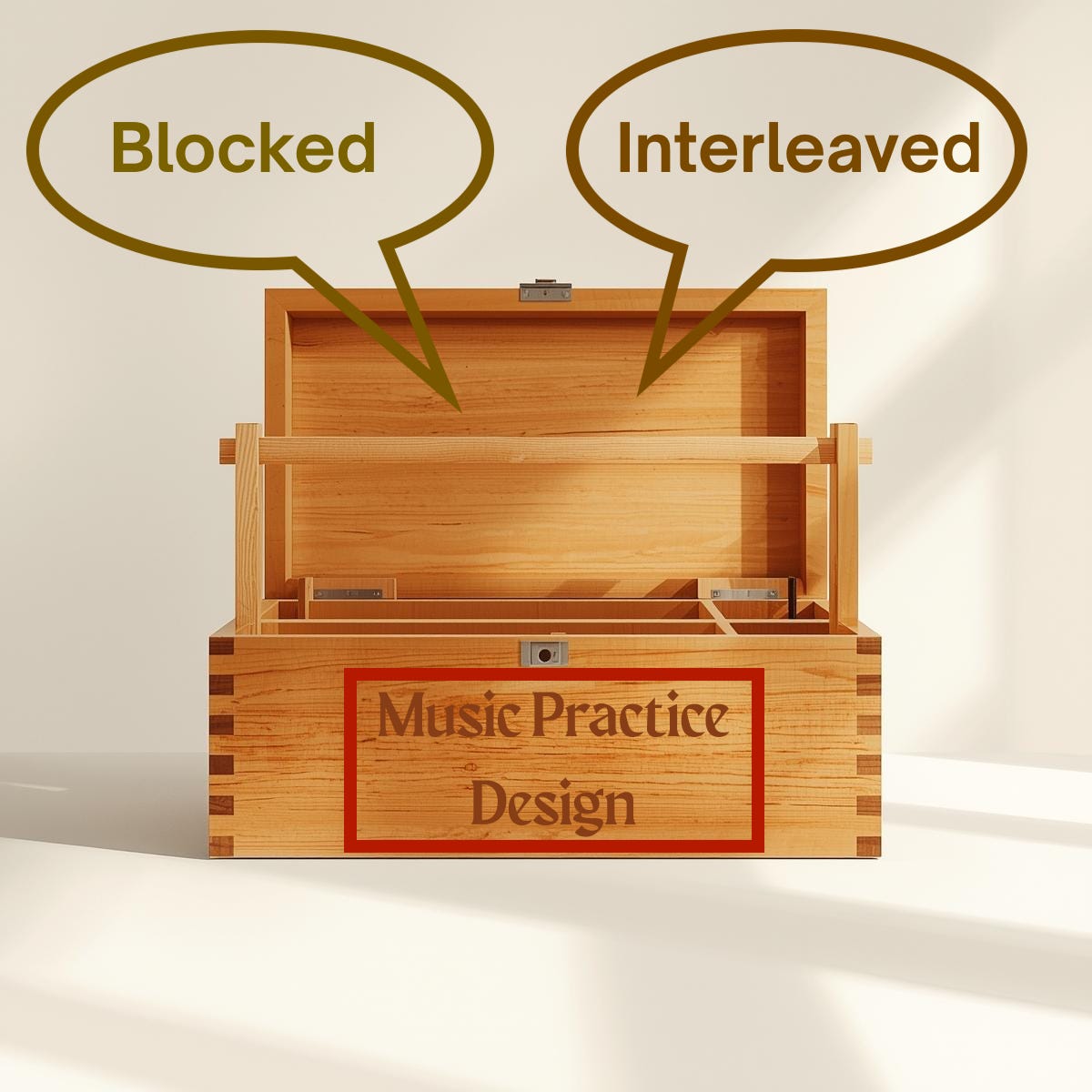
A year or so ago, I was learning Bach’s Invention in D major. I had grown accustomed to chunking1 the whole piece into basic musical forms and designing rep set goals2 from them. I diligently worked through all of them, successfully reaching each goal.
A few days later, when I started working through those same rep sets again, I got frustrated. This time, I was struggling to reach goals I had already reached.
“Why am I having such a difficult time? Hadn’t I learned this already?”
And it wasn’t just one goal; it happened almost every time.
I’d followed my usual approach: deliberate, systematic practice, focusing on one thing at a time until I’d mastered it. At least, I thought I’d mastered it. For years, this approach had served me well through performance projects large and small.
So what was different this time?
At the end of one of those frustrating practice sessions, I took my own advice: I reflected on what I was doing.
Was I not concentrating enough? Should I design the rep sets to require more correct repetitions?
Then I remembered the idea of “interleaved practice”. I had heard about it from a number of sources. I went back to my written notes and searched for that term. I discovered an entry I’d made during a course of Noa Kageyama’s I’d taken: Blocked practice works best in the early stages of learning...interleaved practice is better in later stages, especially closer to performance.
That’s when it hit me. I was in the early stages of learning this piece - my mental representations3 were still new and vulnerable. Of course blocked practice alone wasn’t giving me the immediate results I wanted. I needed varied contexts to strengthen those shaky mental images. The real problem was my practice design, and my frustration was caused by my unrealistic expectations.
Then my reflection took another turn. I realized I’d actually been using a mix of blocked and interleaved practice since my original practice upgrade in 2016.
When preparing for musical theatre shows or vocal recitals - working on 5-25 pieces at a time - I’d practice them in rotation, jumping between sections or running whole pieces depending on what needed attention. Before I learned that there were words for what I was doing, I just called it “good project management” (that was my background experience).
My reflection helped me see more clearly why I was struggling, and how I could redesign my practice for the Bach piece. Blocked practice alone wasn’t giving me the varied contexts I needed to develop my mental representations; interleaved practice would. I needed a thoughtful and intentional combination of both approaches, not just one.
So how does that work? In what ways does block practice work better at the beginning and interleaved practice work better closer to performance?
When I’m unfamiliar with a piece of music, I want to spend time getting to know it. Focused, repeated practice of one aspect after another allows me to build small initial mental representations. In this way, I get familiar with the music, develop basic competence, and establish the foundation for future learning.
This is what I was doing with the Bach Invention. I had designed a series of repetition sets for specific sections. I was able to get clear on the basics of notes and rhythms, work out fingering, and get a sense of how one moment flowed into the next.
This is the best time to use blocked practice: during initial learning designed to help you build specific skills by giving you focused time with the new material.
In contrast, as I became more familiar with the Bach piece, I designed interleaving into my practice sessions. I had 8 separate sections of the piece that I put on rotation. Rather than multiple repetitions at a time (as with blocked practice), I played a single repetition as I moved around the 8 sections. I wasn’t able to rely on the momentum of multiple repetitions. I had to pull the music from memory without the context of having just played it.
This definitely requires more effort, and we’re more likely to make mistakes. But it’s actually the effortful attempt at retrieval, generally referred to as contextual interference, that strengthens the mental image and creates more effective learning over time. The key is to put an appropriate amount of time between the repetitions - a clear distinction from blocked practice.
So the best time to use interleaved practice is when you’re reinforcing your growing mental images, working on multiple sections or pieces concurrently, preparing for performance: all situations where you design for strong, lasting learning.
So what does this mean for you as a practice designer? It means picking the right tool for the job. You now have two powerful tools in your expanding design toolkit: blocked practice for initial learning; interleaved practice for continued reinforcement and testing.
This lesson is a big step forward! You’re not trying to follow some “right” method. You’re learning about how to make choices. And you see clearly that tools only have value depending on what you’re trying to accomplish.
So, as you design your next practice session, ask yourself: what am I trying to accomplish in my practice today?
When you’ve answered that question, review your tools, and carry on joyfully as the designer of your own musical learning.
Anders Ericsson, in his book Peak, uses the term ‘mental representations’ for the mental images we build of how something works. These representations help us understand, interpret, and organize information, making learning more effective.
Interleave—alternating approaches. I looked it up. Should work wonders for my short attention span.