
In The Loop
Learning to design the loop takes time, and can feel like one more detour to the music.

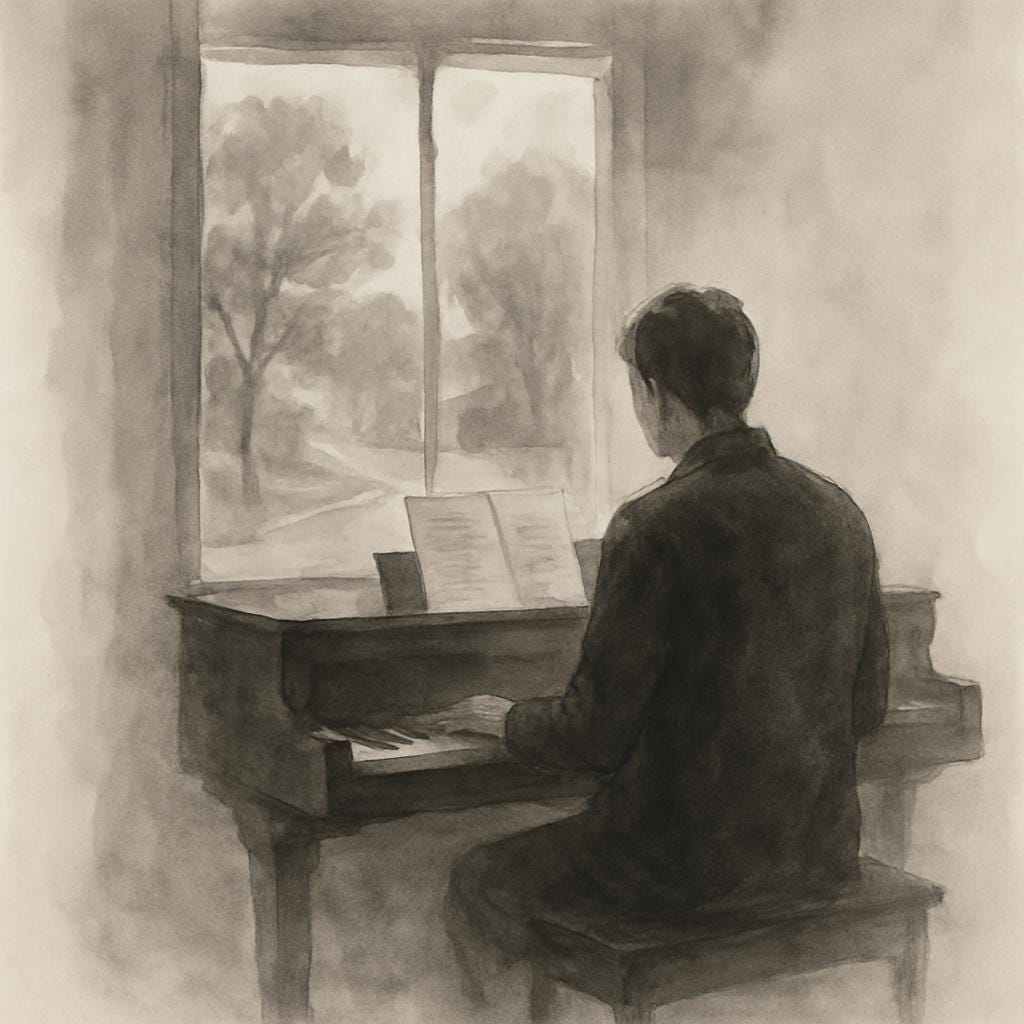
In the practice room, preparing for a rehearsal. This modulation needs to land clearly or the singer won’t know the pitch or beat to come back in on.
Right now, I’m aiming to get it right three times in a row. Several times I’ve gotten two in a row correct, then missed on the third.
The tracking sheet shows the score. With each repetition, that series of 1’s and 0’s gets longer, yet always missing three 1’s in a row.1
I’ve worked with this young singer before. She is going through a painful time in life. Supporting her through this rough moment in the music could be a source of strength for her.
Now, for me practicing alone, each repetition is a mini-drama that could bring me closer to or farther from my goal. Each miss, I imagine us both feeling her confusion and anxiety. Each time correct, we continue to move confidently together with the music.
I finish playing the next repetition. I silently ask myself, as I stand to put my score on the tracking sheet: “Did I get it right?”
I see the long line ending in two “1’s”. I know the score to give myself.
And it doesn’t matter.
Something has hit me. A single moment I have not experienced before. A surge of electric energy through my torso. I stand straighter and look out the window to the trees and neighborhood street.
I’ve forgotten my score. I know only one thing.
I’m in the loop.
I recall those four measures. My fingers, hands, and arms climbing up to that unexpected chord oddly placed in the measure before the singer returns. I hear and feel it all fall neatly into place. I pick up the worn yellow pencil to make the mark on the tally sheet.
I gaze out the window again and return to my seat. Still bathed in the pulse and flow of the music, unconcerned about the score, I begin another repetition.
What was being “in the loop”?
Aiming for a clear target: those four measures, and especially that modulation pivot chord, three times in a row without a mistake. Sitting down on the bench and into imagining the music for that first repetition, every thought, image, motion, hope, and effort intent on the target. Preparation seamlessly moving into play and active engagement. Memory for reflection and keeping score morphing into preparation and the next play of repetition. One after the other, they all become a single action, one continuous movement.
Two steps put you in the loop. The Virtuous Cycle2 is the specific structure of a single repetition, prepare, play, reflect, designed to keep you in motion rather than spinning. The Rep Set3 is the clear target and a way of keeping score.
Learning to design the loop takes time, and can feel like one more detour to the music. Design leads us to flow, and to the heart of the music.
Learning to swim gave the boatman what he needed to navigate the river.
You’re in the practice room. For the last ten minutes, you’ve endured the inconsistent movement of your bow, too often causing that scratching sound as you drift off the straight line you’re attempting to draw.
You’re aiming to correctly move from one string to the next five times. In this moment, you’ve gotten it right four times in ten tries. Just one more repetition – done correctly – and you’re done with this exercise.
You ask yourself, “Do I have to visualize it again? I got it right already. I should just do it again without thinking. It’s easier. I want to get to the next thing.”
You lower your bow arm to your side. You’ve shut your eyes, tight. The violin still tucked between your chin and shoulder. Thinking. Not about how to do the repetition. About whether to practice a new way.
Looking out the window, the trees seemed to get in the way of my view. Preparing to complete my last repetition, I knew that my neighbors were still there.
If you’d like to experience the loop in your own practice, on Wednesday July 15, I’m offering a free online presentation on the two steps that can put you there. Look for the Substack Live announcement on Monday.
The Recapitulation section from the Starter Page shows you how to build your own Rep Sets.
I keep going back to what Theodor Leschetizky says about practicing. He advocated for spending a significant portion of practice time thinking about the music rather than just playing, often having students study without looking at the score to build a mental image of the piece. The pauses, however long they are between repetitions, are the key.
Nice explanation. Great ending. Brought us into the moment.