
On Creative Patience
Finding Virtue Within Discipline and Openness

The Schedule That Wasn't: Confronting Creative Limitations
For the past four weeks, I've struggled with something I've come to call "creative patience." When I first encountered it this time (yes, it's been an ongoing struggle), I recognized it as plain ol' "impatience"—specifically, impatience with my publishing output.
In April, I was able to publish four pieces in the first two weeks. At the time, that schedule had great appeal to me. I had recently "re-launched" my identity on Substack to align more completely with my deepest interests and to realize my hopes and dreams for this last third of my life. I was enamored with the notion that I'd be sharing new pieces—one each from Gillyweed (fiction) and Reimagining Music Practice (non-fiction)—every week. Without much reflection, I decided this would be the "delivery schedule" I'd commit to.
It didn't take long to realize this schedule was unrealistic. Yet the tension remained: modern creative culture encourages constant production and visibility while true creation often requires space, reflection, and—yes—patience. In these four weeks, I've come to realize that this tension isn't just pragmatic, it's deeply psychological and spiritual.
Listening to Impatience: From Obstacle to Oracle
I'm one of those people who believes that creativity is a spiritual practice. Like any spiritual path, this "practice" is available to anyone; it is not a "talent" that you are "born with." My approach blends spiritual practice with Jungian psychology, creating a framework where creative struggles become meaningful rather than merely frustrating.
When faced with an explosion of creative ideas—many of which I loved and became deeply invested in bringing to fruition—I discovered the limits of my ambition within my self-imposed timeframe. Suddenly, I was confronted with the "opportunity" to practice what my archetypal ideals preached. And I have to say, it didn't go smoothly. There was no "conversion in the desert"—unless by "conversion" you mean three weeks of regular psychological adjustment to reality.
What I discovered was that my impatience wasn't simply a schedule problem; it was an invitation to a deeper relationship with my creative work. My rushing often served fear rather than creation—fear of not being productive enough, fear of losing momentum, fear of failing my own expectations. Learning to read these signals became a form of what archetypal psychology calls "aisthesis"—the heart's way of perceiving. Rather than seeing impatience as merely an obstacle, I began to view it as guidance for my creative process.
Chronos and Kairos: The Necessary Tension of Creative Time
Part of what I've discovered is that at the heart of creative patience lies a fundamental tension between two archetypal energies: Chronos and Kairos.
Chronos represents clock time—the desire to complete work according to specification on a given schedule. It's the archetypal energy of discipline, commitment, and external accountability. Without Chronos, creative ideas might never be realized.
Kairos, meanwhile, represents the "right moment"—the desire to allow the work itself to determine when it is complete. It's the archetypal energy of receptivity, insight, and attunement to the work's inherent rhythm. Without Kairos, creation becomes mechanical production rather than authentic expression.
What I knew intellectually, and have come to understand through experience, is that this tension is not a problem to solve but an ongoing conversation to actively engage in. The virtue of this engagement lies not in choosing one source of energy over the other, but in developing the wisdom to honor both—knowing when to push forward with discipline and when to allow creative ideas and images the space they need to develop organically.
For me, I was willing to give Kairos a couple days a week to help me be the kind of writer I'd dreamed of being—a hopeless expectation. If suitable work didn't appear in that time, Kairos would be be pushed aside by Chronos and told that "your work here is done" and it was "time for the big boys to take over". Now I recognize that true creative patience means both of these energies are essential, not allowing either to dominate completely.
Patient Presence: Embodying the Balance in Daily Practice
The practical embodiment of creative patience comes through cultivating an attention that is both active and receptive. Rather than imposing predetermined expectations on my work, I've learned to perceive not just the physical presences of words and music but their psychic reality as individual "beings" with their own unique character or "face"—how they "appear".
This approach stems from aisthesis—a way of perceiving which recognizes that creative work has its own soul and timing. Instead of asking "when will this be finished?" I ask "what is this becoming?" Aisthesis isn't passive observation but immediate, embodied openness to the qualities of things as they present themselves. This practice unites objective perception with subjective imagination.
Another embodying question, "What kind of boss do I want to be to myself?", has become especially helpful and poignant. Having spent years in the corporate world with a variety of bosses, I have clear distinctions and preferences about how to treat myself. Do I want to be the driving taskmaster who values output above all else, or the nurturing mentor who recognizes that quality emerges from a balanced approach to the creative process? (Answer: mentoring is more my style and largely my need.)
I'm also developing the practice of regularly inquiring about my inner experience as I'm working. While realizing that stress is inevitable, I attempt to remember to perceive my experience objectively. What is my stress level? Is it too much? Is it positive and healthy or unhelpful or even destructive? Is my desire to publish on a predetermined schedule harming my work's soul?
My new practice includes physical supports as well. Knowing that my physical states strongly influence my psycho-spiritual energies, I've found the Pomodoro technique—a repeating set of on/off work periods—to be especially helpful. My current schedule is 30 minutes of work followed by 10 minutes of rest, with rest periods often including some form of movement and hydration.
Beyond the Keyboards: When Creative Patience Transforms Life
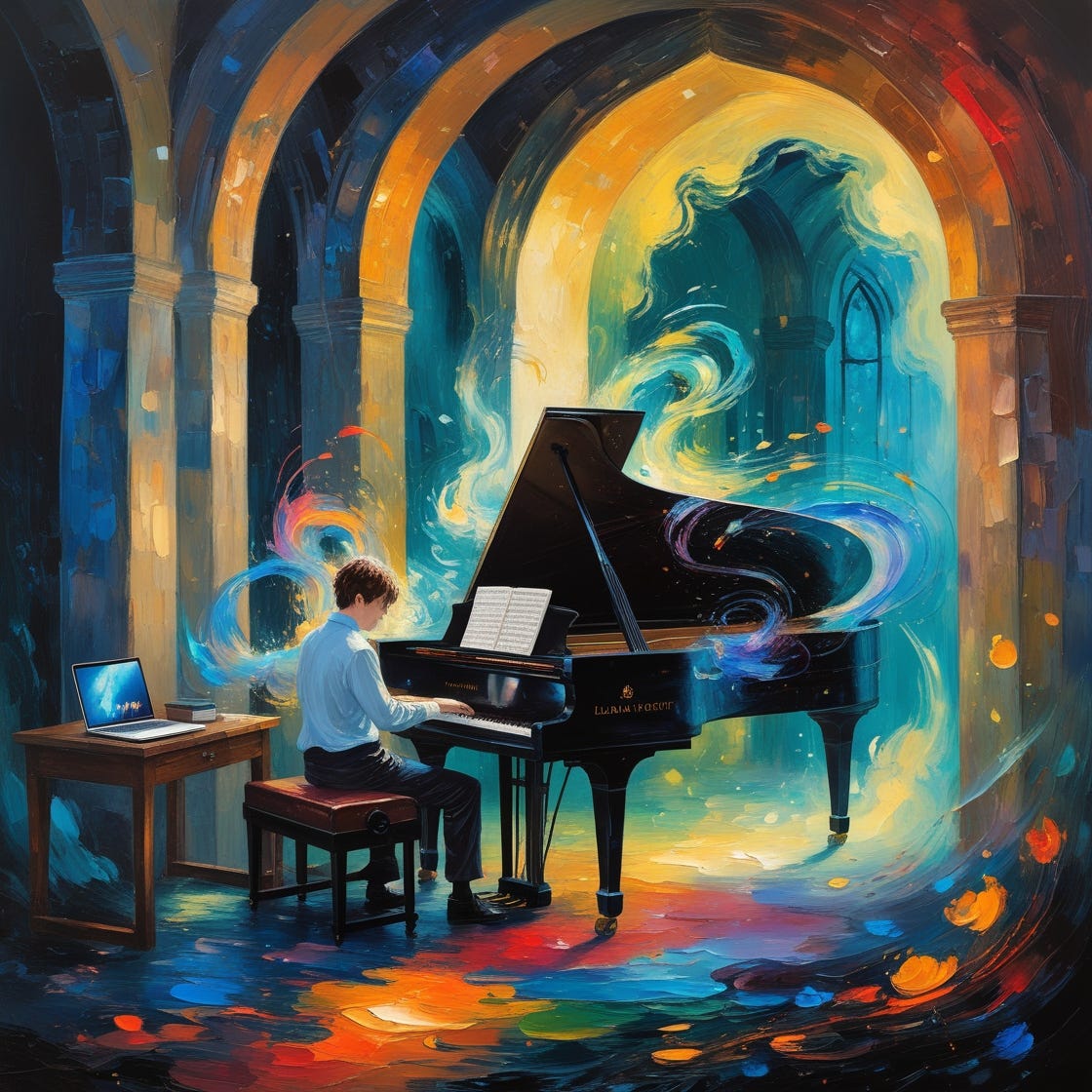
One of the unexpected gifts of cultivating creative patience has been its positive impact on my life beyond my creative work (my "keyboards" are a piano and a laptop). Allowing myself the "times between" of creative patience, I've had time and energy to give to other areas of my life.
When I can "put my work away" for extended periods, I am more present in relationships. I am also more likely to look forward to and engage in projects, such as creating outdoor and indoor gardens for the first spring in our new home. I notice I have more energy for social activities. I'm taking more time for reading, puzzles, and even watching Oilers post-season hockey!
All of this has given me a more well-rounded life and a stronger sense of who I am in the world. What began as a pragmatic adjustment to an unrealistic publishing schedule has blossomed into a deeper, more integrated approach to living creatively in all dimensions of life.
The Fuller Circle: Extending Patience
When I rush my work to meet an arbitrary schedule, I'm not serving those who engage with it. I've come to understand that creative patience isn't just a gift I give myself. It's also a gift for you, Dear Reader, as an authentic encounter with the creative mysteries, delivered with its soul intact.
This realization hasn't "solved" creative patience for me. It remains an ongoing practice I'm actively developing, a virtue to be cultivated rather than a problem to be fixed. There are still days when Chronos shouts loudly and days when Kairos whispers softly. But the awareness of both, and the recognition that they form a necessary creative tension, has transformed my relationship with time and with my creative work.
The paradox, of course, is that patient creation often flows more abundantly in the long run. By allowing my work the time it needs to develop naturally, I create from a place of wholeness rather than fragmentation, leading to work that resonates more deeply—even if it arrives a little later than my ambitious schedule might prefer.
I invite you to join me in this practice of creative patience. Notice your own relationships with Chronos and Kairos. Pay attention to when you rush and when you linger. Observe the quality of work that emerges from different approaches to time. And perhaps most importantly, extend the same compassion to yourself that you would offer to a dear friend or beloved student on their own creative journey.
After all, the virtue of patience isn't measured by calendars but by the integrity and authenticity of what we bring into the world.
Post Script
Part of the joy that comes from creative counterpoint is discovering and expressing the confluences where the two rivers of my work—Gillyweed and Reimagining Music Practice—meet. The "inciting incident" for this present piece of non-fiction was my work on the forthcoming fictional piece, "Breakthrough". In it, Francesco—my alter-ego protagonist for the entire Gillyweed saga—endures a transformation similar to the one I have described here.
"Breakthrough" began as a relatively straightforward—though not simple—story. Before long, it linked to another—though related—idea I had been working on. I soon realized that in order to properly tell the story of "Breakthrough", I had to publish the other story—"Game of Tag"—first.
But wait—there's more! While writing about creative patience, I began to discover that the counterpoint between "Creative Patience" and "Breakthrough" was already existing.
In other words, in Francesco's story, he is reclaiming his creative voice; coming to grips with creative uncertainty; experiencing psychological transformation through the creative process; learning to trust the emergence of inner impulses, images, and needs; practicing to develop and integrate creative technique with authentic expression.
To sum up, the experience of the last month confirms for me what I've always believed about the creative process and my particular perspective on the "eternal golden braid" we all share:
It was only by consciously and creatively living through the transformative process of experiencing, coming to grips with, and sharing with you my struggles with creative (im-)patience that I was able to perceive the confluence of what I believe to be the archetypal images and energies—not just of chronos and kairos—but of all the spirits and souls that inhabit Gillyweed and Reimagining Music Practice.
Post-Post Script
Although "Breakthrough" is well on it's way to completion, I'm not committing to when it will be published. But I do promise that when it is published, its currently fragmented soul will be intact.
What an amazing piece, Paul. I am going to save it and share it and return to it often. You have taught me so much, and helped me feel less alone and clearer about my creative struggles. Thank you for writing and sharing this beautiful work of art.
Oh wow, I hear you Paul. I too have bursts of creativity and then weeks of drought where Chronos is breathing down my neck and cranking up the guilt.
But as a reader I really appreciate the thoughtful heart driven pieces. I don't mind if they come sporadically (actually I often prefer that they do) because they aren't forced (it is so obvious when a piece is forced into existence and then sent into the world just because it's Tuesday).
I'm looking forward to the next Gillyweed adventure whenever you are ready to publish it.
- Katherine