
Keeping Score
Turning a repetition into something that counts.

We’ve all had this experience. You sit down to practice, out of a sense of obligation, and you realize that you don’t know what to do.
Okay, warm up. So you go through your warm-up routine. But you’re not really there. It’s automatic. You do the same exercises in the same order almost every time. So you put in somewhere between 5 and 20 minutes and you can truthfully say you’ve practiced.
You turn to the list of pieces you’re working on. And because you’d rather not be there, you pick the one that you like playing the best, so at least you’ll have fun.
But you’re not having fun. You know what you should be working on, and you’re not doing it. You don’t want to. Instead, you imagine all of the other musicians in the world who are working hard to develop their skills while you’d rather be anywhere else. And you wonder, what is wrong with me? I’m not a real musician. It shouldn’t be this hard to get going.
Here’s what I believe – about myself and anyone else who’s had this experience.
The problem is not us. We are human. We are not machines. We have experiences like this.
Traditional music education teaches us how to play our instrument. Music, as a set of skills, is technically very demanding. Teaching any instrument well is difficult. So, the master-apprentice model in music has survived for centuries.
And, it leaves us alone in the practice room. We get time with our teacher, if we’re lucky, for an hour a week. The rest of the time, we have to be our own teacher. A role that is seldom identified. And we’re certainly not trained for it.
Here’s the good news: we can actually learn the skills of teaching ourselves. And you can start by changing how you do two things. It will take some time, and some getting used to. But if you learn to use these tools and develop the habit of using them in practice, you will take two big steps in that direction.
Here are the two things to change:
how you do each repetition
how you gather repetitions to aim at a single, clear target
Each repetition has 3 steps.
Prepare yourself to play by thinking about and imagining what the music will look like, sound like, and feel like in your body.
Play with full engagement according to your preparation, and pay attention to where you play consistent with your intent and where you don’t.
Reflect on your playing. What do you keep and what adjustments do you make to get closer to your target?
The imaginal magic that pulls repetitions together during a rep set is the link between reflection and preparation. You immediately use the information you get while playing to help you prepare to play the next repetition.
For a fuller description of the basic repetition, see this footnote.1
Gathering repetitions to the same goal creates a repetition set (or, rep set).
A basic rep set definition could be:
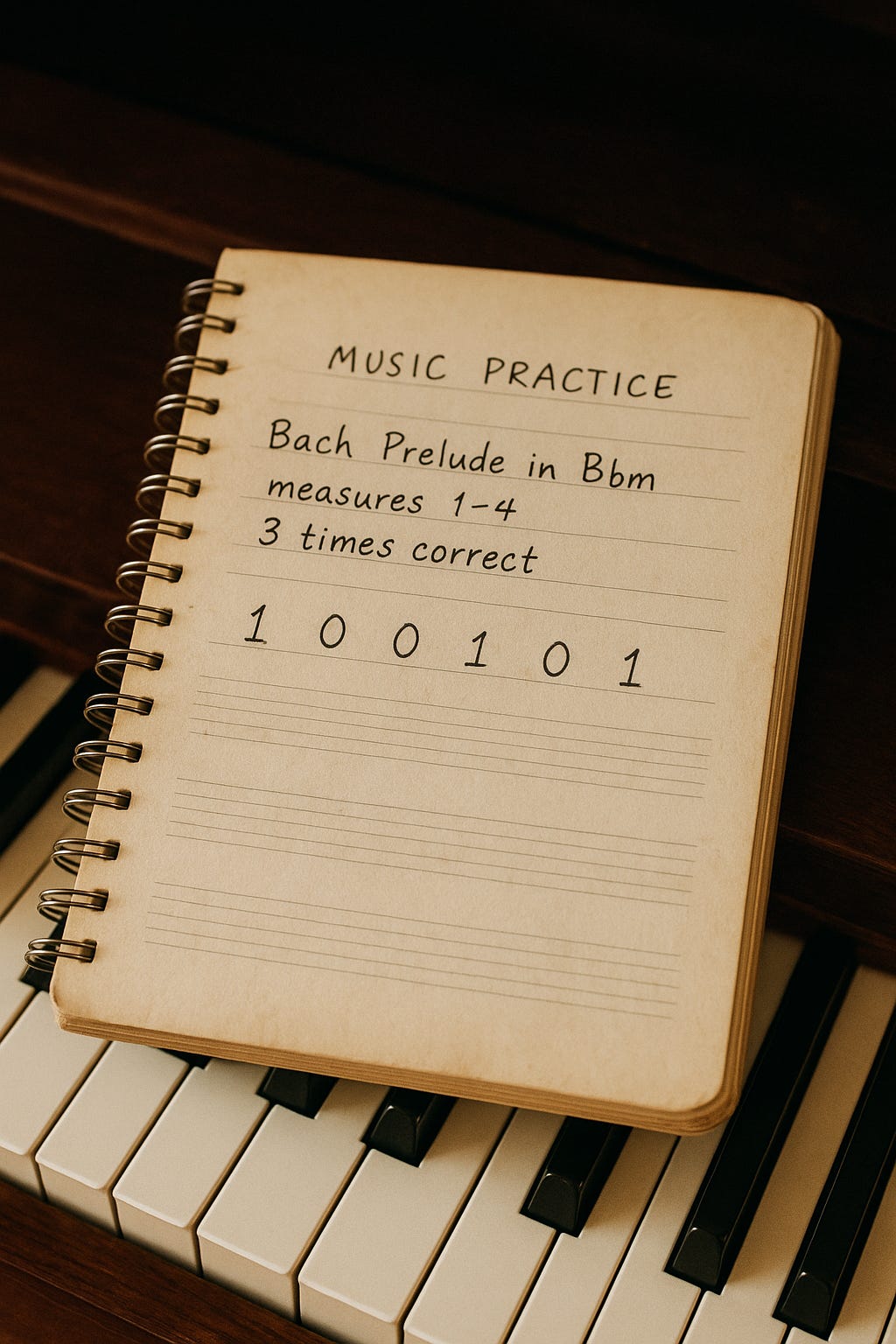
Play measures 1 - 4 correctly three times.
There are many ingredients that can go into designing a rep set. They include:
Chunking and integration – taking a piece of music apart, learning each part, then gradually putting it all back together again.
Nesting – creating a short mini-goal focusing on a very specific problem while in the middle of a rep set.
Tempo – beginning at slower tempos and gradually increasing speed over additional rep sets for the same area of music.
For more details about how to use these ingredients individually and together, see this footnote.2
And, there is one more element of rep set definition that gives you momentum to get through the finish line of your goal.
That ingredient is Keeping Score. Here’s a simple illustration of how it works.
You’ve written your rep set goal in your practice notebook: “Play measures 1 - 4 correctly three times.” Then, for each repetition you play correctly, you put a mark (a check, a number 1, etc.) in your notebook. When you have three marks, you’ve reached your goal.
Keeping score builds momentum to get to the end because it makes your practice feel more like a game. Here are a few of the ways it does this.
A clear end condition. If you know what “correctly” means to you, three times is unambiguous. You know when you’ve reached the end and when you haven’t.
No guaranteed outcome. Even though you know the end point, an assured result wouldn’t be a game.
A visible record. You always know how close you are (or not) relative to your end goal. What’s more, the gradually growing line of marks gives you a sense of moving toward your desired outcome.
You sit down to practice.
You do your warm-up, then open your notebook.
There, you find where you’ve written your rep set goal: “Play the notes and rhythms of measures 1 through 4 correctly three times.” You’ve just started to learn this piece, but you’re familiar with it. You’ve carved out this chunk to begin with. You know what the music looks like, sounds like, and you have an idea about what it feels like in your body.
Soon, you’ve made four attempts and gotten two correct. Two marks underneath your written goal. You prepare for the next rep. Your body is electric with anticipation and focus. You begin. The first two measures go well. You know that the third measure is where the tricky part is – the spot where the last two mistakes have been made. You recall your preparation in your imagination, and your body follows. You’ve gotten past that spot! You begin to celebrate. Suddenly, a note that you’ve always gotten right before is missed by a full step. There is a stinging sensation in your chest and throat. You know you missed getting the mark this time. You finish. You’re very disappointed. You were so close.
During reflection, you sigh and shake your head. But you know what happened. For a split second you lost concentration.
You know what you need to do next time. Play it just like you did, but keep your focus until you’re all the way past the end.
Now you shake your head and smile. So close. And, you know very clearly what you need to do this time.
You finish preparation, and begin to play. Once again, the first two measures go well. In the third measure, you are now clear about that tricky spot and get through it cleanly. Then, remembering your preparation, you keep your attention on the present moment. No celebration yet. You get to the end.
You pick up the pencil and give yourself the mark on your score sheet. Looking at the three check marks, you put down the pencil and stand up. You reach your arms up over your head. Now is the time to celebrate!
Sitting back down, you realize that a miss belongs to the game, not to you.
Being alone in a music practice room can be discouraging, even demoralizing. But the confusion you feel there was never a flaw in you. It was a gap in what you were taught. You were given the instrument. You were not given the craft of practice.
These two changes are where that craft begins. They take some getting used to. They are also completely learnable, and you can start with your very next repetition.
I’m offering a free online workshop on these two ideas. It isn’t a presentation. You bring a real problem from your own practice, something you’re stuck on or unsure how to approach, and we work through designing a rep set for it together. Bring the specific piece and the specific spot if you can.
Wednesday July 22 at 3:00pm Mountain Time, on Zoom. Use the button below and type “Workshop” and I’ll send you the Zoom link.
If you’d also like to see last Wednesday’s presentation, type “Replay” in the same message and I’ll send you that link too.
The Recapitulation section from the Starter Page shows you how to build your own Rep Sets.
I kept thinking of baseball and getting seven chances to make a hit.