
Earned Effortlessness
You can't flow with the river before you learn to swim

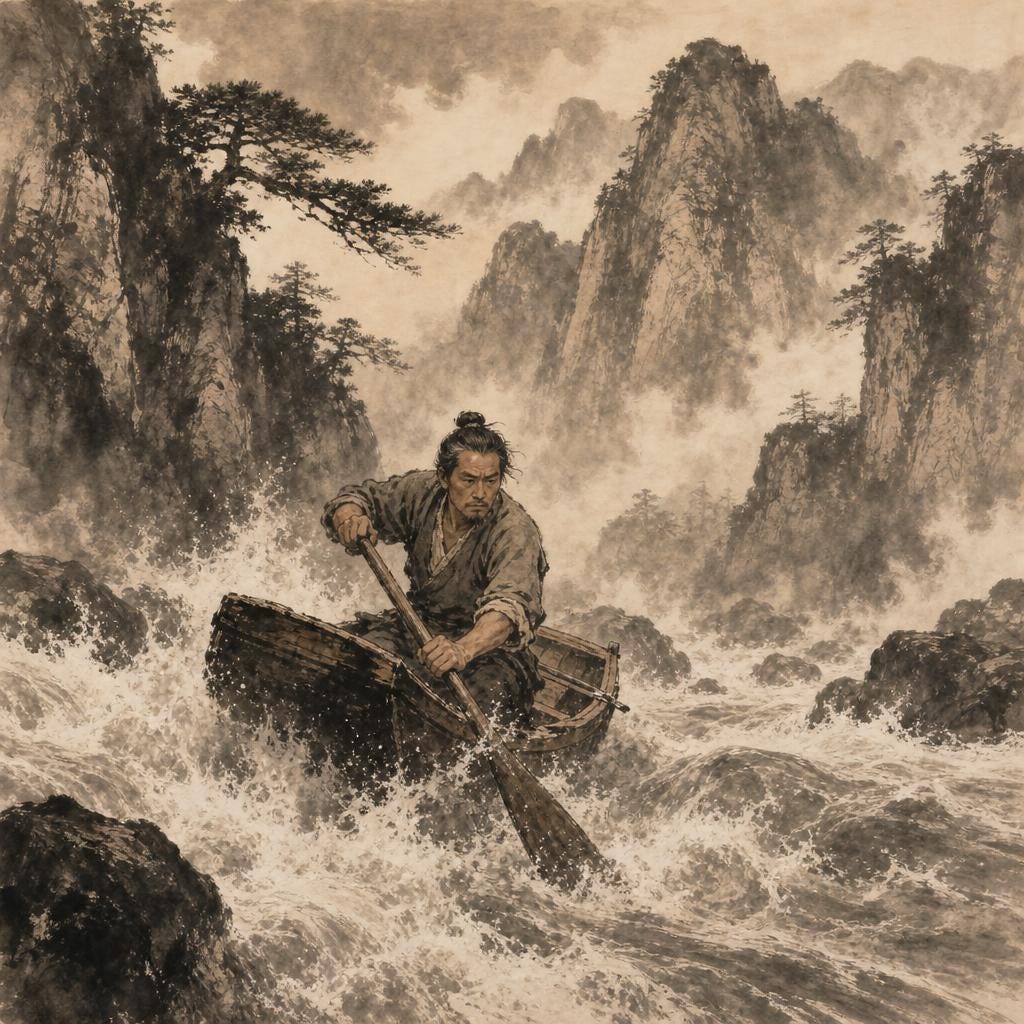
You’ve probably been told to “just get out of your way”, or “don’t try so hard”. This recommendation displays a kernel of wisdom.
On the surface, it can be alluring. We are attracted to the belief that all of our efforts will somehow coalesce into a lovely experience of flow. So, you may have felt in that moment that the advice wasn’t completely wrong. It’s just that, if taken literally, you’re left with nothing tangible to do.
If you’re a novice boatman learning to navigate through a storm, you’re going to bring everything you’ve learned to every moment, so you don’t end up crashing on the rocks.
If you’re sitting in the practice room learning a new piece, preparing for a performance, or cracking the nut of a complex polyrhythm, what are you bringing to that moment so you can accomplish that goal?
The answer isn’t in doing less. It’s in doing more of the right things.
I was the lone accompanist for a production of the musical Company. It was the most technically and musically demanding challenge I’d ever faced.
Opening night, the lights dim for the first number. The murmur of the audience diminishes. The entire theatre is hushed, anticipating the opening chords that abruptly bring the show to life.
In that moment, backstage, the score is in front of me, my hands are poised on the keyboard. My body and mind are tense, alert, and apprehensive. The next moment, as the music director gives the upbeat – the last second before we begin – I am certain that if I stay focused and trust all the effort I have put into preparation, I will fulfill my role.
I was the boatman who had learned to navigate the storm. Every experience as a musician throughout my life was there with me. The lessons, the rehearsals, the performances. The listening, the thinking, the imagining. Teachers, students, mentors. Decades culminating with a solid month of purposeful practice.
My certainty was more like faith in a prior self who had done the work, in the teachers who shaped me, and the roles I’d filled.
Before I could navigate the storm, I had to learn how to swim.
In the moment of that upbeat, I knew I could swim.
Getting out of your way to allow your practice to come through you is not something you do. It is an attainment. Wu wei, or the experience of flow, arrives of its own accord.
The word “accord” echoes the musical sense of “being in harmony”. It is distantly related to the English word “heart” and the metaphoric phrase “from the heart of things”.
It feels as if you’ve arrived at the place it already exists. This is why the experience of wu wei is a paradox. You don’t do wu wei. You remove the obstacles – self-doubt, grasping, over-trying – that create dissonance. And you can only reach the possibility of that experience by having done the difficult and scary work of learning to swim first.
Nerves and imperfections are the conditions of the work, not evidence of inadequacy.
You’ve had teachers, lessons, listened, thought, imagined; been to rehearsals, performed, and probably taught others. Whatever your experience, you already have what you need. You’re a musician who already makes music. You want to make music better.
The boatman isn’t waiting for calm conditions before he trusts himself. Neither should you. The rough water is the point. Keep swimming. Teach yourself to swim better.1
The boatman as a figure of wu wei appears in the Zhuangzi (Chuang Tzu), the foundational Taoist text attributed to the philosopher Zhuang Zhou (4th century BCE). In one passage, a master boatman tells a disciple of Confucius: “If you want to be a good boatman, don’t worry about controlling the boat. Make sure you can swim — and you can control the boat.” The mastery of swimming precedes the freedom to navigate. The three-line poem in the painting that inspired this post carries the same logic: 乘风破浪 / 身手如神 / 一任江流 — “Ride the wind, break the waves / Skills like a god / Entrust yourself entirely to the river’s flow.” The third line only becomes possible because of the second.
“Nerves and imperfections are the conditions of the work, not evidence of inadequacy.”
This lands for me. Remembering that practice is not about getting rid of our anxiety of performing but of developing the skills necessary to be prepared to meet the challenges we face in those situations. Great read🤩
This sentence sticks out for me. The answer isn’t in doing less. It’s in doing more of the right things.
That's at the heart of my last post about the cost of busyness. It's less about how much you do and more about the impact of each thing you do, big or small. But the image of that boatman in the white water. Wow! Kind of scary!